
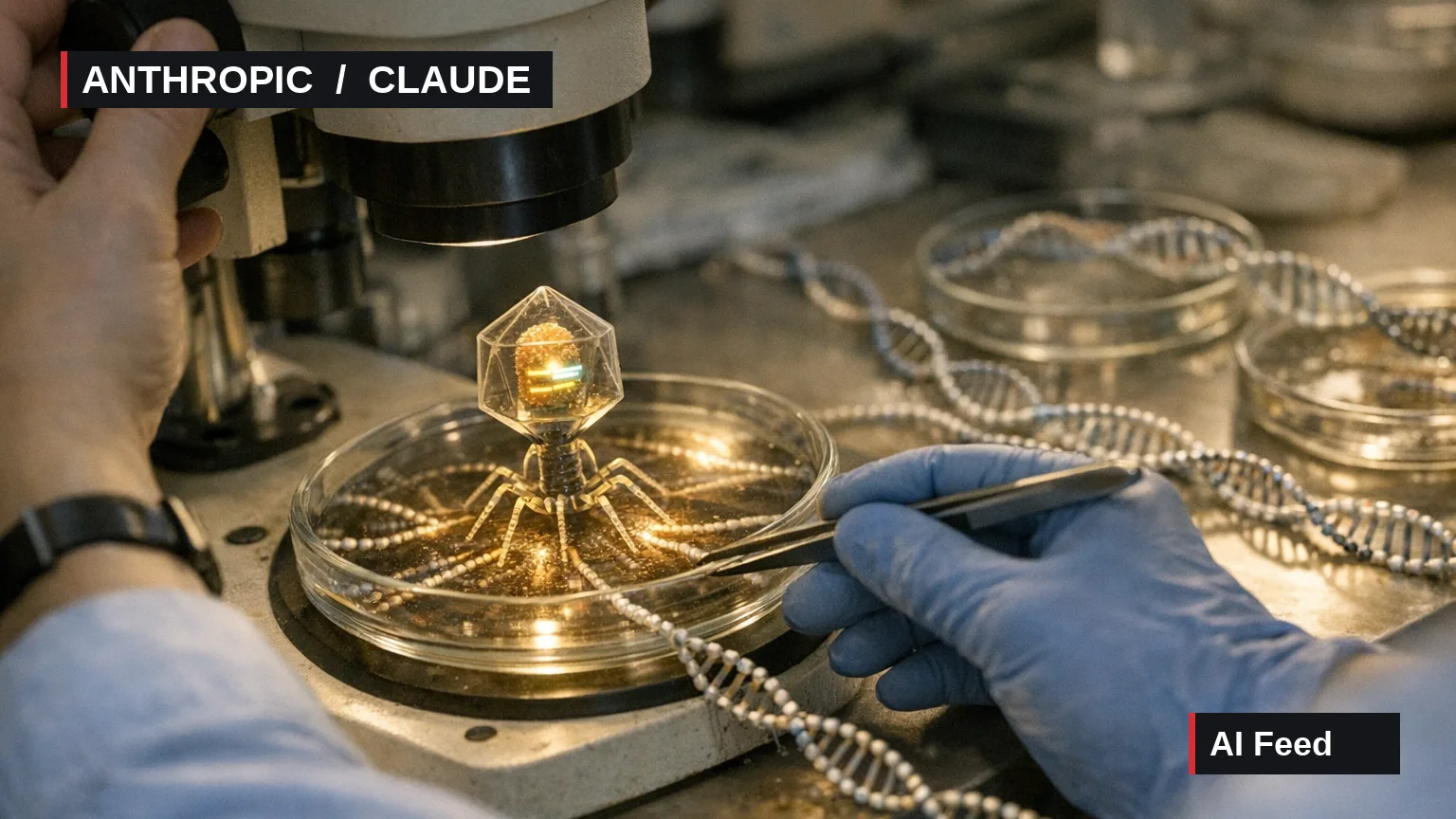
Anthropic said on September 23 that Claude helped identify a previously uncharacterized enzyme system associated with repeating DNA sequences. Named array-associated reverse transcriptases, or ART, the system has an organization reminiscent of CRISPR, but its biological function has not yet been determined. The result is an early project from Anthropic’s new life sciences research group and laboratory.
The company gave Claude a broad assignment: search a large DNA-sequence database for interesting examples of reverse transcriptases, which copy RNA into DNA. Roughly 950 agents used 210 million tokens over 21 hours to examine enzyme families and select candidates. Anthropic said human involvement in that search was limited to the initial prompt, while scientists performed the laboratory work.
The agents gathered more than 200,000 reverse transcriptases, identified 3,500 candidate systems and narrowed the set to 20 candidates for detailed reports. One agent noticed evenly spaced DNA repeats beside an unusual reverse transcriptase gene, then counted the repeats, measured their spacing, compared the arrangement with known systems and searched the literature for earlier reports.
According to Anthropic, ART occurs mainly in bacteriophages and has three components: a reverse transcriptase, a neighboring partner gene and a long array of evenly spaced DNA repeats. The reverse transcriptase itself, found in a jumbo phage, had appeared in previous research. Anthropic describes the newly recognized system—particularly its non-coding array and an accessory protein of unknown function—as the discovery.
Anthropic’s initial experiments found that the ART array is expressed as a collection of distinct short RNAs. That feature invites comparison with CRISPR arrays, whose RNA sequences help make CRISPR-Cas systems programmable. The company nevertheless cautioned that ART’s primary function remains unknown; its report does not establish that ART cuts, copies or pastes DNA, or that it can become a biotechnology tool.
The project illustrates Anthropic’s proposed division of work between AI and scientists rather than a finished product. Claude searched sequences, evaluated hypotheses and prepared readable candidate reports; researchers selected surviving candidates and tested them biochemically and structurally. The team used Claude Science, Claude Code and, at times, an internal harness coordinating parallel Claude sessions. All physical experiments were performed by human scientists.
Practical context: For now, the practical result is the selection and preliminary validation of an unusual genomic system, not demonstrated utility for ART. Parallel agent searches may reduce the effort required to screen large sequence collections, but the approach’s scientific value will depend on reproducible laboratory evidence and a clearer account of ART’s function. Anthropic has published the early findings in a preprint and says further experiments are underway.
Laboratory safety limits
Anthropic’s Bay Area laboratory operates only at the lower BSL-1 and BSL-2 biosafety levels, does not handle pathogens capable of infecting humans, and assigns all physical experiments to human scientists.
Sources
Event date: 2026-09-23. Primary source date: 2026-09-23.