
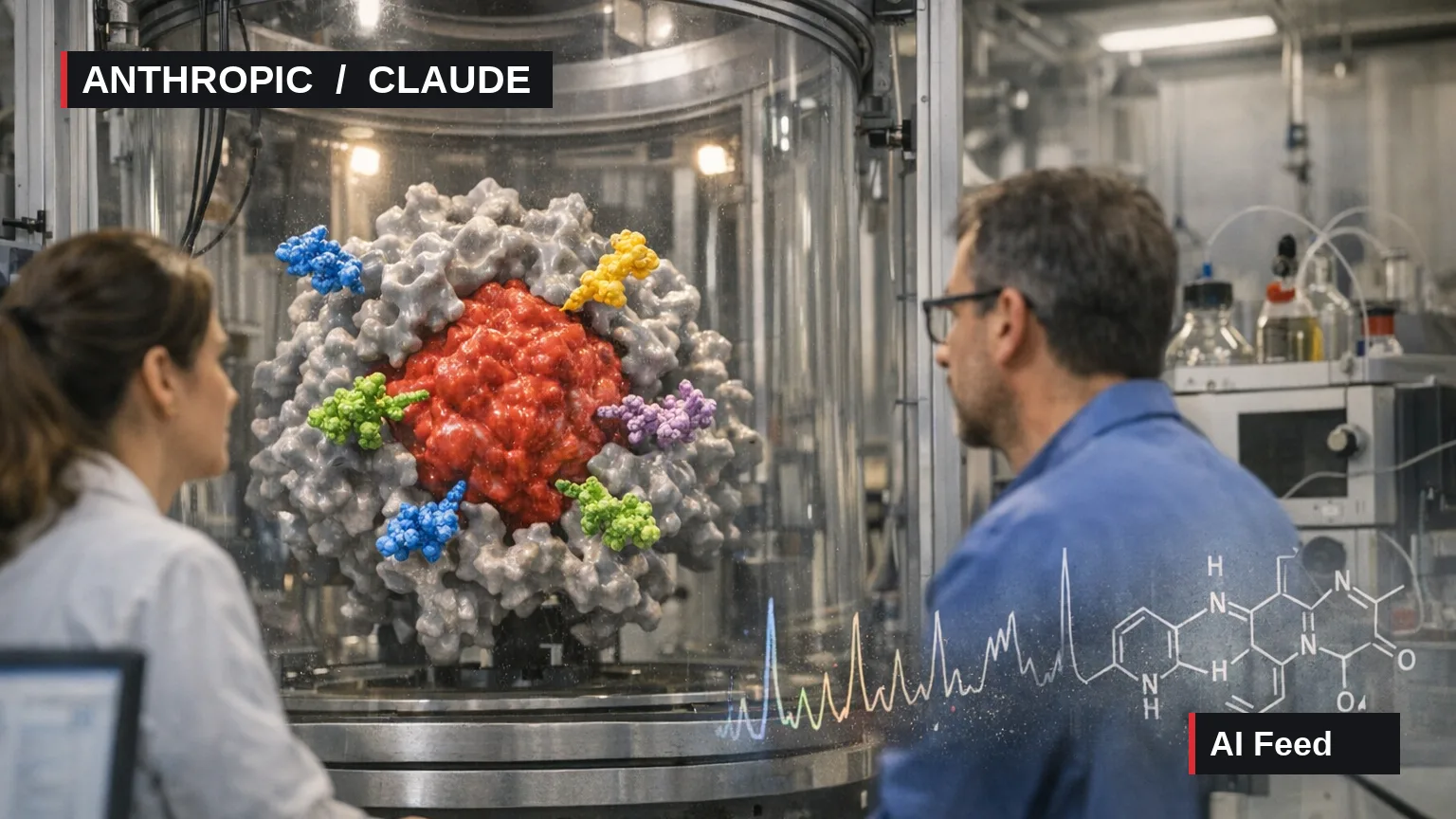
Anthropic reported two scientific experiments involving Claude on August 18, 2026. Mythos Preview and Opus 4.8 designed minibinders from scratch for specified protein targets, while the generally available Opus 5 model processed raw nuclear magnetic resonance and liquid chromatography–mass spectrometry data.
In the protein campaign, laboratory testing confirmed binders for 14 of 15 targets. Anthropic reported overall hit rates of 26.7% for Mythos Preview and 22.6% for Opus 4.8 when each model worked across all targets during a 48-hour session. In separate 24-hour sessions focused on individual targets, Mythos Preview reached 35.1%. The company compared these figures with a typical campaign range of 10% to 15%.
Claude was supplied with scientific literature, internet access, computing resources, and specialist protein-design and folding models. After the initial prompt, it selected target regions, generated candidate structures and sequences, ran computational optimization cycles, and screened candidates. Across the campaign, 354 of 1,320 designs were confirmed as binders for 14 targets.
Adaptyv Bio and Twist Bioscience produced and tested the designs. Results varied substantially by target: none of the 90 designs for maltose-binding protein was confirmed to bind, although one produced a weak, reproducible signal. Anthropic said it plans more extensive characterization to verify hit rates and affinity measurements, and released its prompts alongside the resulting in vitro and in silico data.
For the chemistry experiment, Opus 5 received a contract laboratory’s raw files for a routine quality-control sample and a short plain-language prompt. According to Anthropic, it returned processed NMR results in 23 minutes and LC-MS results in 19 minutes, without vendor software or an operator. Hydrogen counts differed from the laboratory’s results by no more than 0.08 ¹H per peak, while measured purity was 96.4%, compared with the laboratory’s 96.33%.
Practical context: The experiments illustrate two distinct roles for a general-purpose model: coordinating specialist computational tools to design molecules and processing measurements from completed laboratory work. However, the reported metrics apply to these particular experimental configurations and do not establish equivalent performance with other targets, samples, or instruments.
Access differs across the demonstrated capabilities. Anthropic described Opus 5 as its most capable generally available model, while saying life-science research tasks remain blocked in its most capable model because of dual-use risks. The company is preparing an access program for scientists but did not provide a launch date. All quantitative results were published by Anthropic; although external organizations manufactured and tested the protein designs, the report covers an initial laboratory campaign whose broader validation remains pending.
| Task | Model and setup | Reported result |
|---|---|---|
| Protein design across 15 targets | Mythos Preview, 48 hours | 26.7% overall hit rate |
| Protein design across 15 targets | Opus 4.8, 48 hours | 22.6% overall hit rate |
| Single-target protein sessions | Mythos Preview, 24 hours each | 35.1% overall hit rate |
| NMR processing | Opus 5 | 23 minutes; within 0.08 ¹H per peak |
| LC-MS processing | Opus 5 | 19 minutes; 96.4% purity versus 96.33% |
Sources
Event date: 2026-08-18. Primary source date: 2026-08-18.