

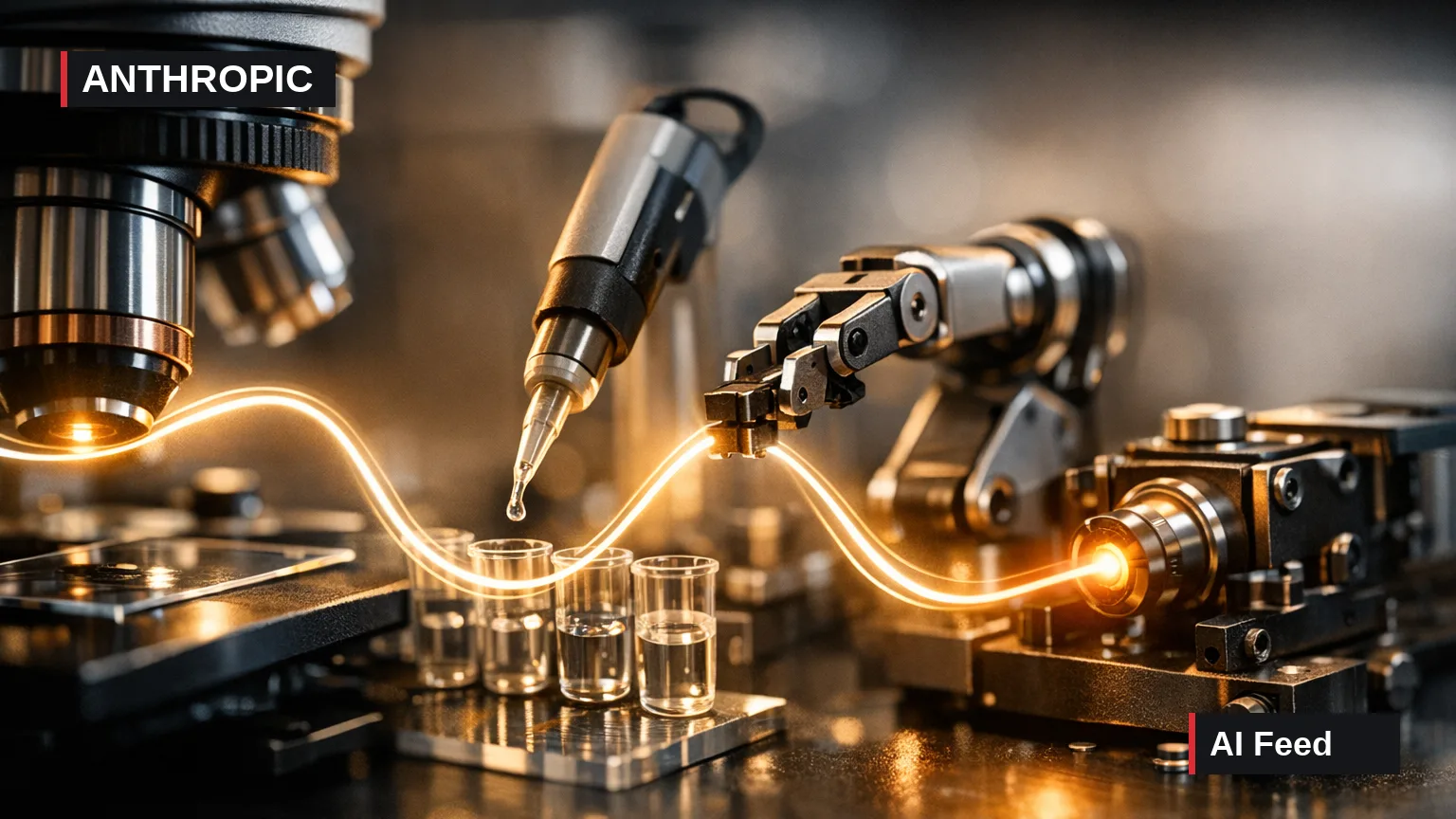
Anthropic opened a research preview of the Model Hardware Standard on August 27, 2026, giving an initial group of scientific laboratories and advanced manufacturers access to the early specification. MHS is designed to let AI agents safely operate physical equipment, including microscopes, liquid handlers and robotic arms. Its development began as a collaboration between Anthropic and the HHMI Janelia Research Campus.
The standard introduces a common software driver in place of bespoke integrations for individual devices. It represents hardware through a standardized, network-discoverable format and uses basic commands such as “read” and “write” to retrieve or change parameters. Anthropic says this approach can reduce integration work that ordinarily takes weeks or months to hours or minutes.
An MHS driver can also supply information that code alone may not reveal, such as a machine’s physical characteristics. Users can enter that knowledge in natural language or answer an agent’s questions about the hardware setup. The driver then produces a reference file describing what the device can measure, which settings can be adjusted and which safety limits must be enforced.
Connected equipment can be controlled through the Model Context Protocol, a command-line interface or code files and APIs. An agent can sequence work across multiple instruments, monitor operating data and adjust parameters as conditions change. For long-running or time-sensitive operations, it can combine driver commands into deterministic code so devices execute the steps without requiring model reasoning throughout the process.
Anthropic reported early results from several partner projects. Carnegie Mellon University researchers used MHS to conduct serial-dilution dose-response experiments about three times faster than before. QuEra said an agent-created controller recovered a laser’s precise frequency lock without human intervention in 99.3% of cases. These figures describe individual partner projects rather than an independent assessment of MHS across operating environments.
Access to the preview is available by application, and MHS has not yet been released as open source. Anthropic plans to work with preview participants on additional safety evaluations and deployment practices, then publish findings when it open-sources the standard. The current version requires equipment to have a programmable interface; Anthropic is working with manufacturers on drivers for hardware that lacks one.
Practical context: In practical terms, MHS is an attempt to provide a shared layer between AI agents and varied scientific or industrial equipment, reducing the need for specialized integration code. Its scope remains constrained: Anthropic says Claude’s spatial and physical reasoning has limitations and still requires expert oversight. In Genentech testing, researchers had to explain that errors caused by foaming samples were physical failures rather than software bugs.
| Mechanism | Purpose |
|---|---|
| Model Context Protocol | Connects an agent to devices through a standard protocol |
| Command-line interface | Provides direct access to hardware-control commands |
| Code files and APIs | Combines operations across devices into reproducible workflows |
Limitations of the MHS research preview
Anthropic says Claude’s spatial and physical reasoning remains limited and requires expert oversight. MHS also does not yet work with hardware lacking a programmable interface, while the standard remains an application-only research preview rather than an open-source release.
Sources
Event date: 2026-08-27. Primary source date: 2026-08-27.