

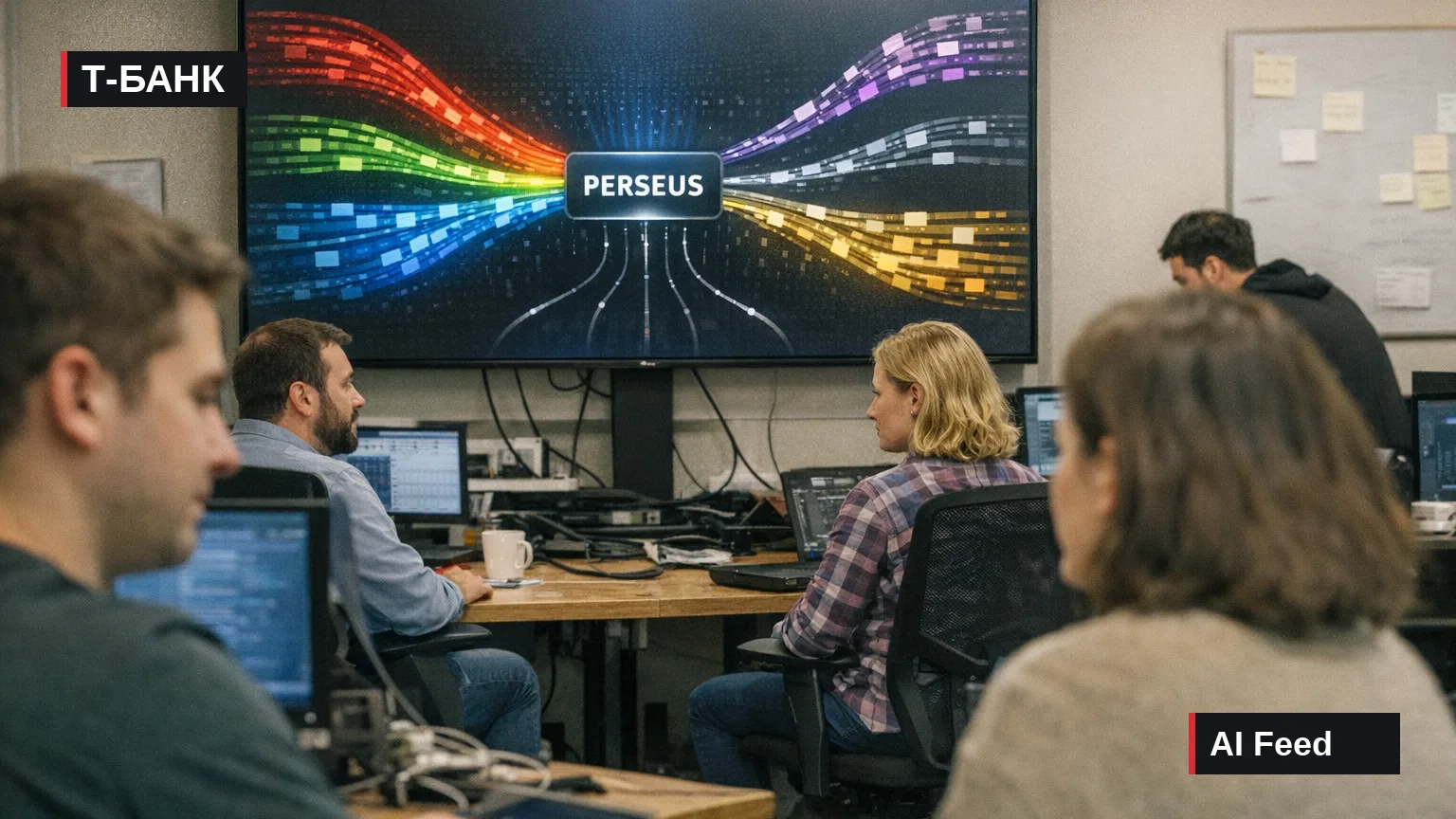
T-Bank published a practical Perseus tutorial on September 11, covering candidate generation, ranking, classification and regression over users’ event histories. Aimed at machine-learning developers, it explains data preparation, commands and evaluation, with accompanying code. T-Bank had introduced the framework earlier at Turbo ML Conf 2026; the new publication provides the detailed implementation guide.
Perseus builds each customer’s history from Event Hub, a shared store of timestamped events linked to client identifiers. Event types can use different schemas and carry optional attributes such as an item or brand. Encoders turn features from events, context or artifacts into embeddings; a backbone combines the sequence and context into a customer representation, while a task-specific head produces the prediction.
According to T-Bank, developers handle four main steps: loading events into Event Hub, preparing task-specific samples, creating a YAML configuration and running training or inference commands. The framework assembles histories, prepares its internal dataset, calculates loss and stores outputs. Available history aggregators include modern_bert as the default, plus bert, ligr, danet, hstu and mamba.
The tutorial uses the small T-ECD dataset, focusing on the Marketplace domain and its view, click, like and clickout events while also incorporating Retail and Offers data. T-Bank says a sequential run through all four task types takes about eight hours on one NVIDIA H100. That timing applies to the described experimental setup and is not presented as guaranteed performance elsewhere.
In T-Bank’s candidate-generation experiment, Perseus using only item_id exceeded a most-popular-items baseline on Recall@100, NDCG@100 and Coverage@100. Adding further features increased all three reported metrics again. These are T-Bank’s results on the selected T-ECD configuration, not an independent framework comparison or a promise of equivalent gains on other data.
The evaluation has an important limitation: Perseus produces a prediction only when the sample has at least one earlier event for that user. The tutorial therefore calculates the baseline across the full basis and uses it to fill missing Perseus predictions. Built-in metrics are calculated during training on the test fold; inference evaluation and baseline comparisons remain the developer’s responsibility.
Practical context: In practical terms, Perseus is intended for teams that want to reuse a common history of user actions across several models rather than construct a separate event pipeline for each task. Results still depend on appropriate time-based data splits, using only features available at inference, and accounting for delays in the arrival of production events.
| Variant | Recall@100 | NDCG@100 | Coverage@100 |
|---|---|---|---|
| Most popular, baseline | 0.1275 | 0.0430 | 0.0005 |
| Perseus, item_id only | 0.1518 | 0.0545 | 0.0056 |
| Perseus with additional features | 0.1553 | 0.0572 | 0.0099 |
Sources
Event date: 2026-09-11. Primary source date: 2026-09-11.