

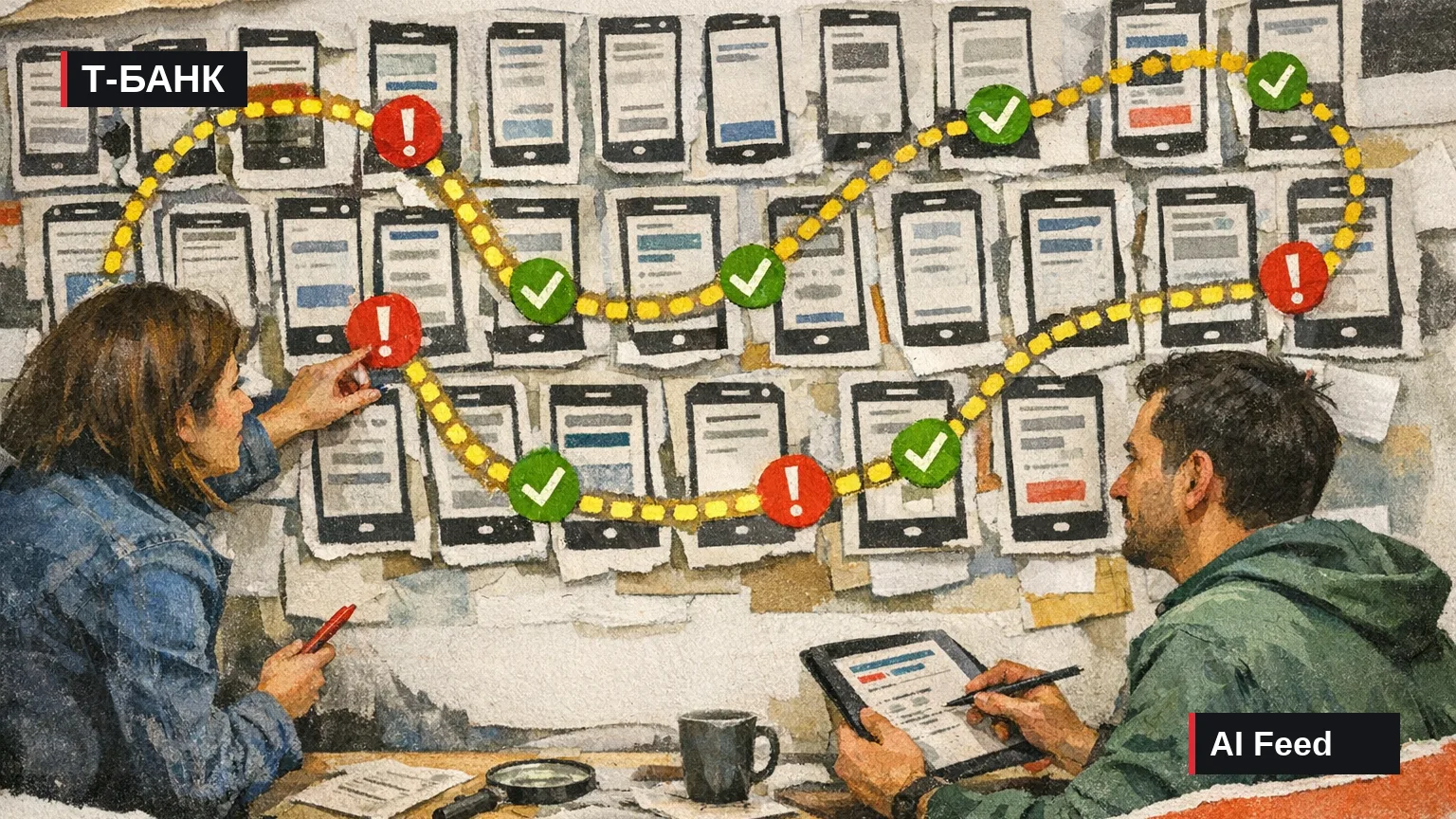
T-Bank has detailed an internal AI-QA agent for regression testing of its mobile application. The system launches the app in an iOS simulator or Android emulator, follows test scenarios step by step, uses a visual language model to interpret screens and compares observed results with expected outcomes. The project was presented as a case study by the bank’s own engineering team.
According to T-Bank, its mobile app has accumulated tens of thousands of test cases, while regression testing takes place twice a month and consumes a substantial share of QA teams’ resources. In the described workflow, an engineer updates the pool of test users, selects checks in Allure and starts a run. The engineer then reviews the agent’s report.
An orchestrator manages the run’s lifecycle: it receives the task, prepares the environment, coordinates the agent and gathers results. A parser converts Allure tests into step-by-step scenarios, a navigation engine controls the device, and a mock proxy substitutes server responses. A custom web platform displays whether a test passed, where a discrepancy occurred, and the associated screenshots and agent comments.
For iOS, the team built a lightweight navigation engine in Swift on top of XCUITest after finding idb insufficiently stable and Appium WebDriver excessive for its limited set of required operations. A Python agent sends JSON commands for taps, swipes, text entry, screenshots and simulator-state management. Android implementations use adb, avdmanager and a UIAutomator wrapper behind a shared platform interface.
The agent primarily relies on screen images when choosing actions. T-Bank said an accessibility-tree approach was inadequate because the app contains hundreds of screens and components, not all of which have sufficiently complete accessibility markup. The VLM examines screenshots and interface state, with reasoning and action handled as separate stages. After each scenario step, the system checks the expected result and stops if verification fails.
The team identified test-case preparation as the most unexpected practical difficulty. Many Allure instructions assume that employees already know the app’s structure, leaving navigation steps and other details implicit. Agent-ready scenarios need explicit routes, scrolling conditions and visually verifiable expectations. T-Bank initially adapted descriptions manually under a set of rules, then began developing a parser combining rule-based handling of common patterns with automated conversion.
Practical context: The case indicates that moving manual regression work to a visual agent involves more than selecting a model and connecting device controls: the underlying test documentation must also be reworked. Visual interaction can reduce reliance on fixed element identifiers, but successful execution still depends on complete navigation instructions and unambiguous expected results. These observations come from T-Bank’s team and were not presented as independently reproduced findings.
Company case-study limitation
The architecture, workflow and observations were reported by T-Bank’s own team; the source does not present an independent reproduction of the results.
Sources
Event date: 2026-09-14. Primary source date: 2026-09-14.