

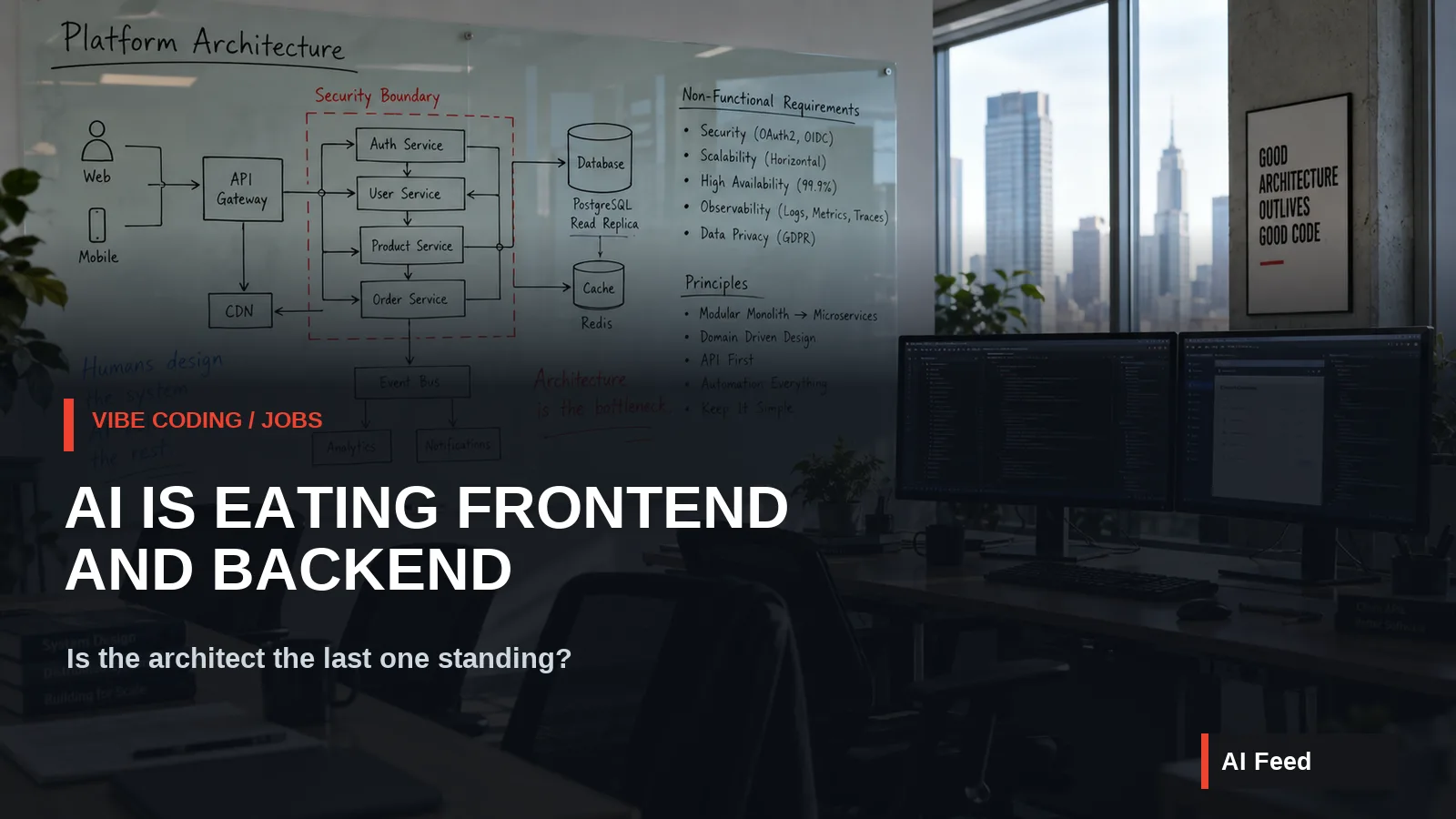
Vibe coding is turning interface work, CRUD, tests and integrations into cheap operations. Frontend and backend engineering will not vanish tomorrow, but the familiar pyramid of implementers is losing its economic logic. The last role standing will be the one that sees the whole system and owns the consequences: the architect.
Key takeaways
- Anthropic classified 79% of Claude Code conversations as automation; JavaScript, HTML and UI/UX work were among the most common uses.
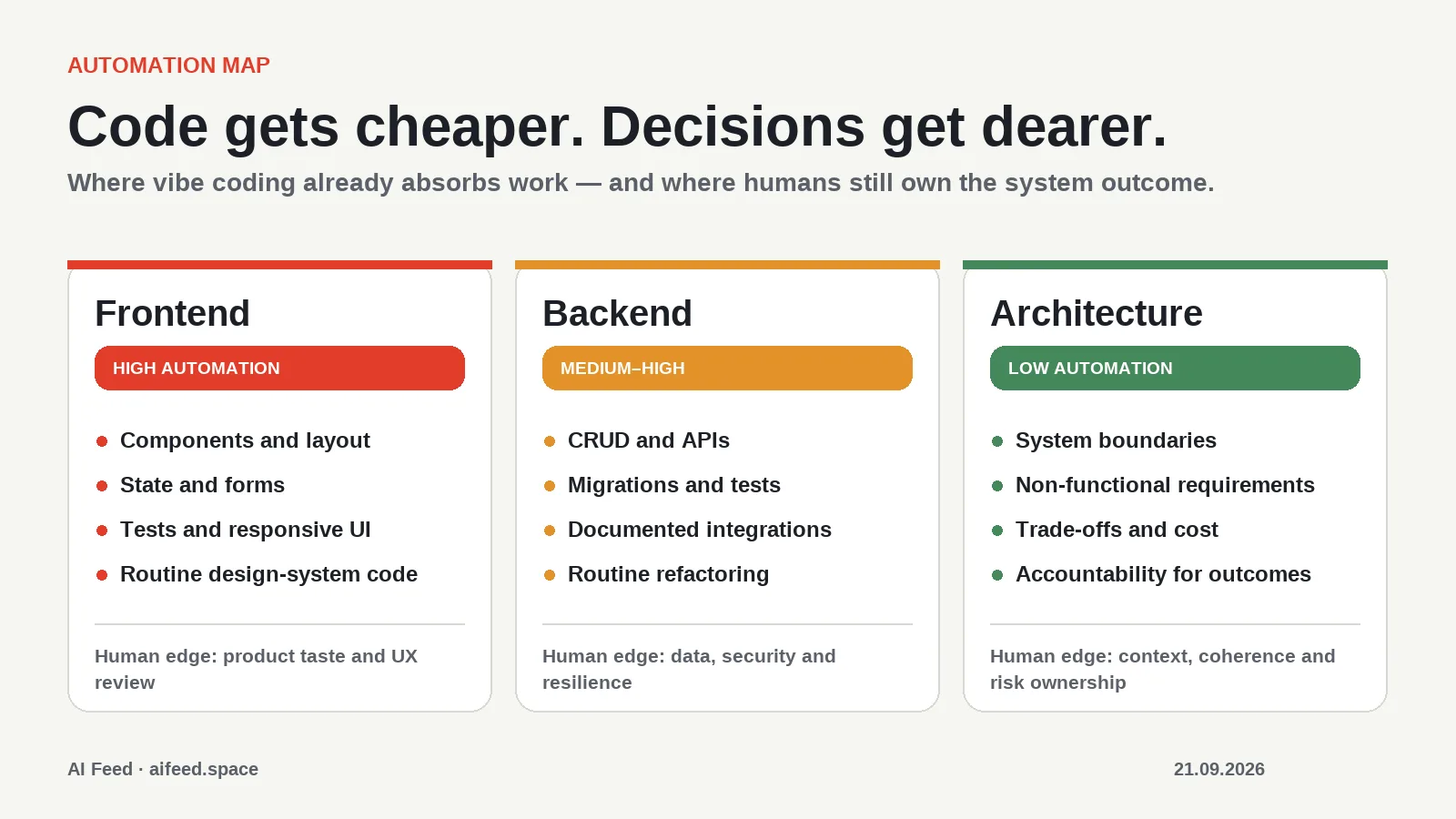
- Routine frontend work is exposed first. Standard backend work follows when the task fits inside a repository and has a clear specification.
- Architecture is more durable because it combines context, trade-offs, non-functional requirements and accountable risk decisions.
- Development itself is still growing: BLS projects US software developer employment to rise 15.8% from 2024 to 2034. What is shrinking is the old team structure and the junior path built on routine tickets.
One architect instead of a department
Software teams have traditionally looked like a pyramid: architects and technical leads made decisions while large groups of developers turned them into interfaces, controllers, integrations and tests. Agentic development changes that economy. An experienced leader can already direct several AI agents and produce work that previously required a separate implementation team.
That is not a statistical forecast. It is, however, an accurate description of the changing economics of software. AI amplifies people who already understand the domain and can judge outcomes. At the same time, it erodes the tasks that once supported the first years of a career: assembling a screen, writing a controller, connecting two APIs, drafting tests and fixing routine defects.
We tested this model against evidence from Anthropic, GitHub, LinkedIn, METR, Stack Overflow, DORA, BLS and the World Economic Forum, separating measurable change from dramatic prediction.
Vibe coding changes the shape of the team
Vibe coding is a workflow in which a person describes desired behavior in natural language while a model writes and changes code, runs commands, reads errors and tries again. In its simplest form it is a conversation inside an editor. In agentic form it is an executor that receives a repository and works from issue to pull request.
The important shift is role compression. A product manager or designer can produce a working prototype without a dedicated frontend engineer. A strong engineer can ask one agent to build the interface, API, migration and tests. The business is no longer buying more lines of code; it is buying less coordination between humans.
AI does not merely replace programmers. It destroys the price of an individual line of code. Specification, verification and accountability become expensive.
Frontend is first in line
Anthropic analyzed 500,000 coding interactions across Claude.ai and Claude Code. In the specialist agent, 79% of conversations were classified as automation and 21% as augmentation. JavaScript and HTML were the most common languages, while UI and UX component development ranked among the leading use cases.
This does not mean 79% of frontend jobs disappear. The number describes how the tool is used. But interfaces offer a fast verification loop: change a component, open the page, observe the result and correct it. A design, browser and codebase provide much of the feedback an agent needs.
| Frontend task | What agents already do | Where humans remain essential |
|---|---|---|
| Page implementation | Build components from a description or design and add responsive behavior | Define and validate the user journey |
| Forms and state | Write validation, loading and error states | Decide which states the product should allow |
| Tests | Generate unit, component and end-to-end scenarios | Choose critical risks and adequate coverage |
| Design systems | Apply existing tokens and patterns | Create the product language and approve exceptions |
Backend follows, then hits invisible constraints
Agents can already build CRUD services, API controllers, schemas, migrations, tests and documented integrations. Vibe-coding platforms demonstrate full flows with interface, authentication, database and deployment. In an Anthropic case study, Rakuten reported reducing feature time to market from 24 working days to five, a 79% decrease.
Backend systems are harder to verify visually. A correct API response today says little about a race condition under load, an authorization failure, lost events, infrastructure cost or disaster recovery. Agents reproduce local solution patterns well. They have a harder time with organizational history, implicit contracts and the price of failure.
Why the architect is last
Architecture begins where there is no single correct answer. A modular monolith may beat microservices. A synchronous call may be safer than a queue. More infrastructure may reduce operational risk—or merely increase the bill. Choosing requires simultaneous awareness of the business model, deadline, people, security, regulation, data and existing systems.
A model can propose options, but it does not automatically receive the organizational authority to accept risk. When a decision causes an outage or breach, a company and named people remain accountable.
GitHub describes the same shift: developer value is moving toward judgment, architecture, reasoning and responsibility for outcomes. Its 2025 research also found that 80% of new developers used Copilot during their first week. Typing code is no longer a sufficient differentiator; understanding which code should exist is.
Verification becomes an industry inside software
The more code agents generate, the less production is the bottleneck and the more verification becomes one. Stack Overflow’s 2025 survey captures the gap: 84% of respondents use or plan to use AI tools, yet 46% distrust their accuracy and only 33% trust it. Just 3% report high trust.
The leading frustration, reported by 66%, is an AI solution that is almost right but not quite. Another 45% say debugging generated code is more time-consuming. The emerging job is no longer writing one function from scratch; it is proving that dozens of agent-written functions are safe together.
Developers draw the boundary where architectural responsibility begins. Seventy-six percent do not plan to rely primarily on AI for deployment and monitoring, while 69% say the same about project planning. These are areas where a locally correct action can create a systemically wrong outcome.
| Level | Generation cost | Failure cost | Primary owner |
|---|---|---|---|
| Component | Very low | Usually local | Agent with fast review |
| Feature | Low | Breaks a user journey | Product engineer |
| Service | Medium | Data and integrations | Backend/platform engineer |
| System | High | Security and downtime | Architect |
| Business | Undefined | Reputation and survival | Human risk holder |
DORA describes AI as an amplifier of an organization’s existing strengths and weaknesses. A team with clear architecture, tests and a platform ships faster. A team with unclear boundaries manufactures technical debt at a new speed.
The evidence complicates the headline
There is little evidence that software engineers as a whole are being displaced. LinkedIn’s 2026 talent report says the hiring slowdown broadly followed the wider technology market. Entry-level hiring had not rebounded by the end of 2025, while skills shifted away from web basics such as JavaScript, HTML and CSS toward cloud and AI capabilities.
The US Bureau of Labor Statistics projects software developer employment to grow 15.8% between 2024 and 2034, adding roughly 267,700 jobs. The World Economic Forum also lists software and applications developers among the fastest-growing roles through 2030.
There is no contradiction. The world can demand more software while each product needs fewer implementers. Demand rises, productivity rises faster, and tasks move between roles. The occupation survives while familiar vacancies and the career ladder underneath it change.
Why experienced developers can be slower with AI
METR ran a randomized trial with 16 experienced open-source developers completing 246 tasks in mature repositories they knew well. With early-2025 AI tools, they took 19% longer, even though they expected to become faster.
Mature systems contain knowledge that is not stored in one file. It lives in decision history, conventions, exceptions and an understanding of what must not break. The more context a task requires, the more expensive generated output becomes to review. AI wins where the outcome is easy to specify and test; experienced humans win where understanding the task is the task.
The new software team
| Old model | AI-native model | Structural change |
|---|---|---|
| Architect, leads and separate frontend/backend teams | A small group of systems engineers directing agents | Fewer hand-offs between roles |
| Juniors start with simple tickets | Models complete simple tickets | The safe training zone shrinks |
| Value follows implementation volume | Value follows decision and review quality | Code becomes an intermediate artifact |
| Specialization protects a career | Broad context combines with deep accountability | Engineers become outcome owners |
The hardest problem is succession. Where do future architects come from if AI absorbs beginner work? One answer is a return to apprenticeship: a senior engineer keeps one junior not as cheap implementation capacity, but to transfer judgment. That costs more today and may be the only way to avoid a future in which nobody can approve the machine’s decisions.
The junior paradox: experience is required before the first job
The career ladder was built on delegation. Senior engineers split large projects into small, safe tickets and juniors completed the cheapest parts. Those well-defined parts are precisely what agents handle best. A company saves on an entry-level role today while removing the process that created its future decision-makers.
LinkedIn does not find broad AI displacement of software engineers, but it identifies the structural warning: entry-level hiring had not recovered by late 2025, and demand is shifting from basic web technologies toward cloud platforms and AI skills. A beginner now competes with both other beginners and an experienced engineer whose output is multiplied by agents.
The largest risk of vibe coding is not the disappearance of programmers. It is the disappearance of the work through which programmers became professionals.
Three market scenarios
Small products: one engineer owns the stack
Landing pages, internal tools, MVPs and small SaaS products will increasingly be built by one product owner or full-stack engineer. Separate frontend and backend jobs become less economical when an agent can implement the complete vertical slice.
Enterprises: less implementation, more platform
Large organizations will retain sizable teams, but their mix changes. Internal platforms, component catalogs, security policies, observability and automated verification become more important. Architecture moves from presentations into machine-readable constraints inside the repository.
Regulated systems: AI writes, humans sign
Banks, healthcare, government and critical infrastructure will use agents extensively while retaining accountability chains. Humans remain because law, audits and customers require an explainable owner for consequential decisions.
Who vibe coding replaces first
- The design-to-code implementer who receives a fully defined task and does not shape the product.
- The routine CRUD author whose output is described by a schema, documentation and tests.
- The integration engineer without domain knowledge where the API contract contains almost all the needed context.
- The developer who does not verify output and turns generation speed into technical debt.
What each role should do now
Frontend engineers
Move upward from components to product behavior, accessibility, performance, design systems and experimentation. Learn to delegate implementation and validate it on real devices.
Backend engineers
Deepen knowledge of data, concurrency, security, observability and distributed failure. CRUD is generated; a correct system under pressure still requires engineering judgment.
Architects
Do not become diagram authors. Learn agentic workflows, encode constraints in repositories, make decisions testable and measure their cost. An architect who ignores AI will lose to an architect who directs ten agents.
A 90-day move from code author to outcome owner
- Weeks 1–2: measure the job. Separate generation, review, context search, coordination and rework.
- Weeks 3–4: delegate one vertical slice. Ask an agent to build the UI, API, migration and tests. Record where human context was required.
- Month 2: turn knowledge into constraints. Put architecture decisions, security rules, verification commands and acceptance criteria inside the repository.
- Month 3: direct multiple agents. Separate research, implementation, testing and review. Do not let the author of a change be its only reviewer.
- End of quarter: recalculate economics. Compare cycle time, rework, incidents and infrastructure cost. Generation speed without quality is not productivity.
Five claims worth debating
- Frontend survives, but separate payment for routine interface assembly contracts.
- Backend survives, but CRUD becomes a by-product of a well-described data model.
- Full-stack shifts from knowing two stacks to owning one vertical outcome.
- Architects without agent experience remain exposed; models already draw attractive diagrams.
- The winners turn tacit experience into machine-checkable constraints faster than competitors.
Will AI replace programmers?
AI does not remove the need for software development. It removes the right to charge a premium for predictable code production. Frontend and backend remain bodies of knowledge, but increasingly become capabilities of one system engineer supported by agents. Separate roles will persist in complex products; mass implementation from a finished specification will contract.
The architect is last not because a model cannot draw diagrams. The role survives while businesses need a person who can see the whole, choose between imperfect options and put their name behind the consequences.
FAQ
What is vibe coding?
It is software development through natural-language descriptions, with AI writing and modifying a substantial share of the code while a person directs and verifies the process.
Will AI replace frontend developers?
Routine layout, components, forms and tests are already highly automatable. Humans remain valuable for product decisions, complex client architecture, accessibility and experience quality.
Will AI replace backend developers?
CRUD, integrations and test scaffolding are moving quickly to agents. Data integrity, security, scale, failure handling and expensive mistakes still require human control.
Should people still learn programming?
Yes, but syntax alone is losing value. Useful training now includes systems thinking, architecture, data, security, domain expertise and rigorous verification of agent output.
Sources and methodology
- Anthropic Economic Index: AI’s impact on software development
- Anthropic / Rakuten case study
- GitHub: The new identity of a developer
- Stack Overflow Developer Survey 2025: AI
- DORA: State of AI-assisted Software Development 2025
- LinkedIn Economic Graph: U.S. Software Engineer Talent Landscape, 2026
- METR: experienced open-source developer productivity study
- U.S. Bureau of Labor Statistics: AI, IT and employment, 2024–2034
- World Economic Forum: Future of Jobs Report 2025
Updated September 21, 2026. Risk ratings are AI Feed editorial assessments based on task structure and the cited evidence; they are not forecasts of job losses.