
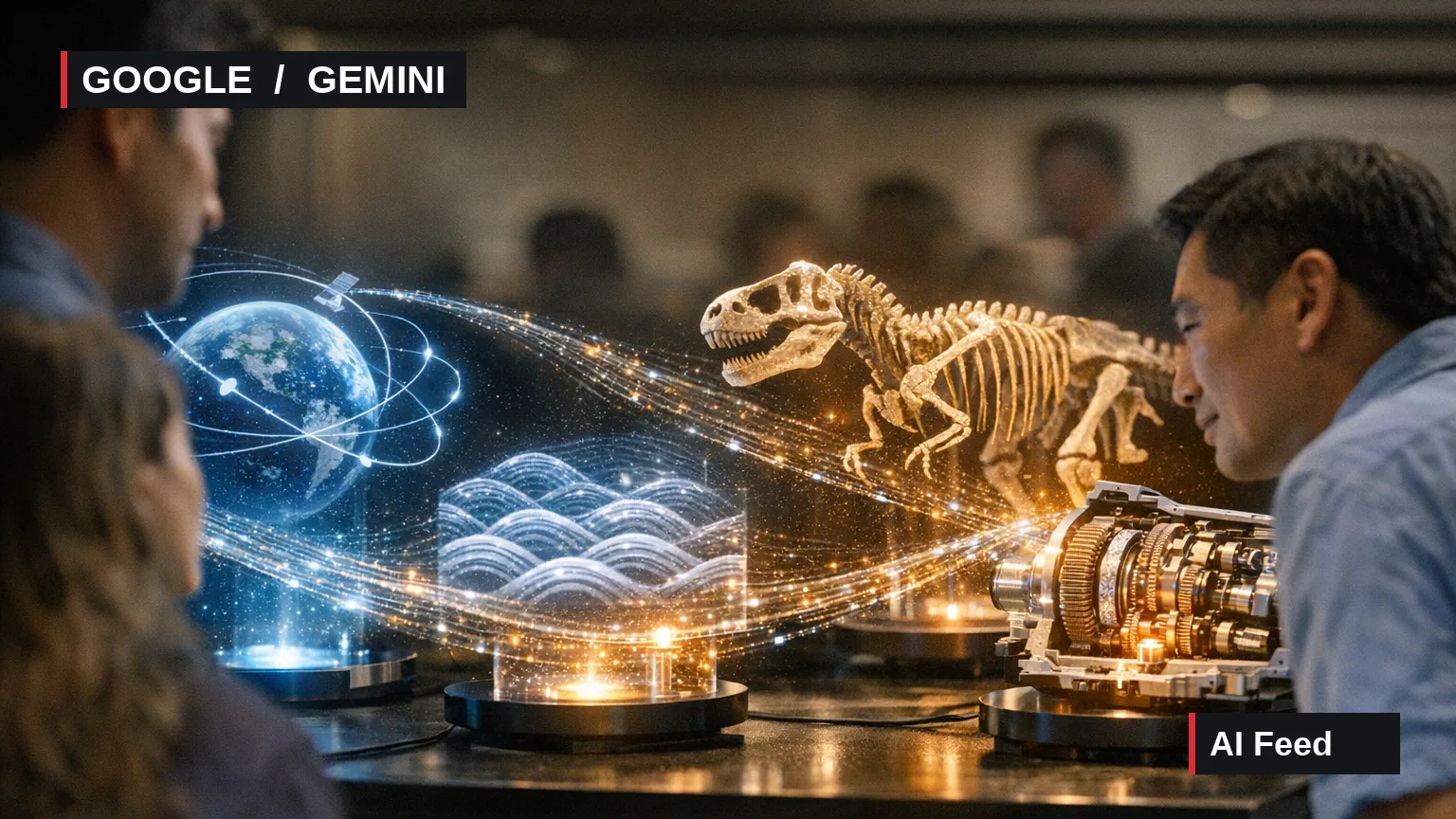
Google has highlighted four community projects made with Gemini 3.8 Flash: a live map of orbital objects, an animated Japanese pattern, a 3D Tyrannosaurus rex skeleton and an interactive automatic-transmission model. The September 28 post showcases uses of the already released model rather than introducing another version.
The company describes Gemini 3.8 Flash as its most capable workhorse model for software engineering, agentic tasks and specialized problems requiring critical, multistep reasoning. Google says the model takes additional reasoning steps on complex tasks and can call tools iteratively to improve its output. The post does not provide independent measurements of quality or latency.
Official demos
Four projects in motion
These are the original videos from Google’s post. Each clip shows the actual project output rather than an editorial reconstruction.
For the space project, Ashutosh Shrivastava combined Gemini 3.8 Flash with Google Antigravity to map the live paths of satellites, space stations and orbital rockets. In a separate visual experiment, Noctus used the model’s multimodal capabilities to turn seigaiha waves, a traditional Japanese pattern, into a composition resembling a moving ink painting.
A third project explored whether the model could follow an extended set of constraints. Emily requested a T. rex skeleton through a four-phase prompt incorporating strict requirements, prohibited shortcuts and accuracy checks. Google presents the result as an example of multistep reasoning in STEM, although the post supplies no quantitative assessment of the skeleton’s anatomical accuracy.
Hakm’s engineering prototype is described in the greatest functional detail. Built from scratch as an interactive automatic-transmission model, it includes 10 camera views, four display modes, smart labels and a side panel explaining any selected transmission component. Google does not state that the prototype underwent engineering validation, so the post supports treating it as an interactive build demonstration rather than a verified simulator.
Practical context: Together, the examples illustrate a broad mix of coding, spatial representation, multimodal input and constraint-following tasks. They remain projects selected by Google, not a comparative evaluation, so they do not establish repeatability, operating cost or an advantage over competing models. Developers can try Gemini 3.8 Flash through Google AI Studio and integrated Google tools including Antigravity.
| Project | Builder | What it demonstrates |
|---|---|---|
| Space-object map | Ashutosh Shrivastava | Paths of satellites, space stations and orbital rockets |
| Seigaiha animation | Noctus | Multimodal transformation of a pattern into a moving composition |
| 3D T. rex skeleton | Emily | Execution of a four-phase prompt with strict constraints |
| Transmission model | Hakm | Interactive engineering visualization with 10 views and four modes |
Sources
Event date: 2026-09-28. Primary source date: 2026-09-28.