


Artificial intelligence is now appearing in corporate layoff reports, but headlines often mix three different forces: direct automation, ordinary restructuring and a broad hiring slowdown. This analysis separates the evidence, identifies the tasks most exposed to AI and explains why jobs usually change before entire occupations disappear.
Key findings
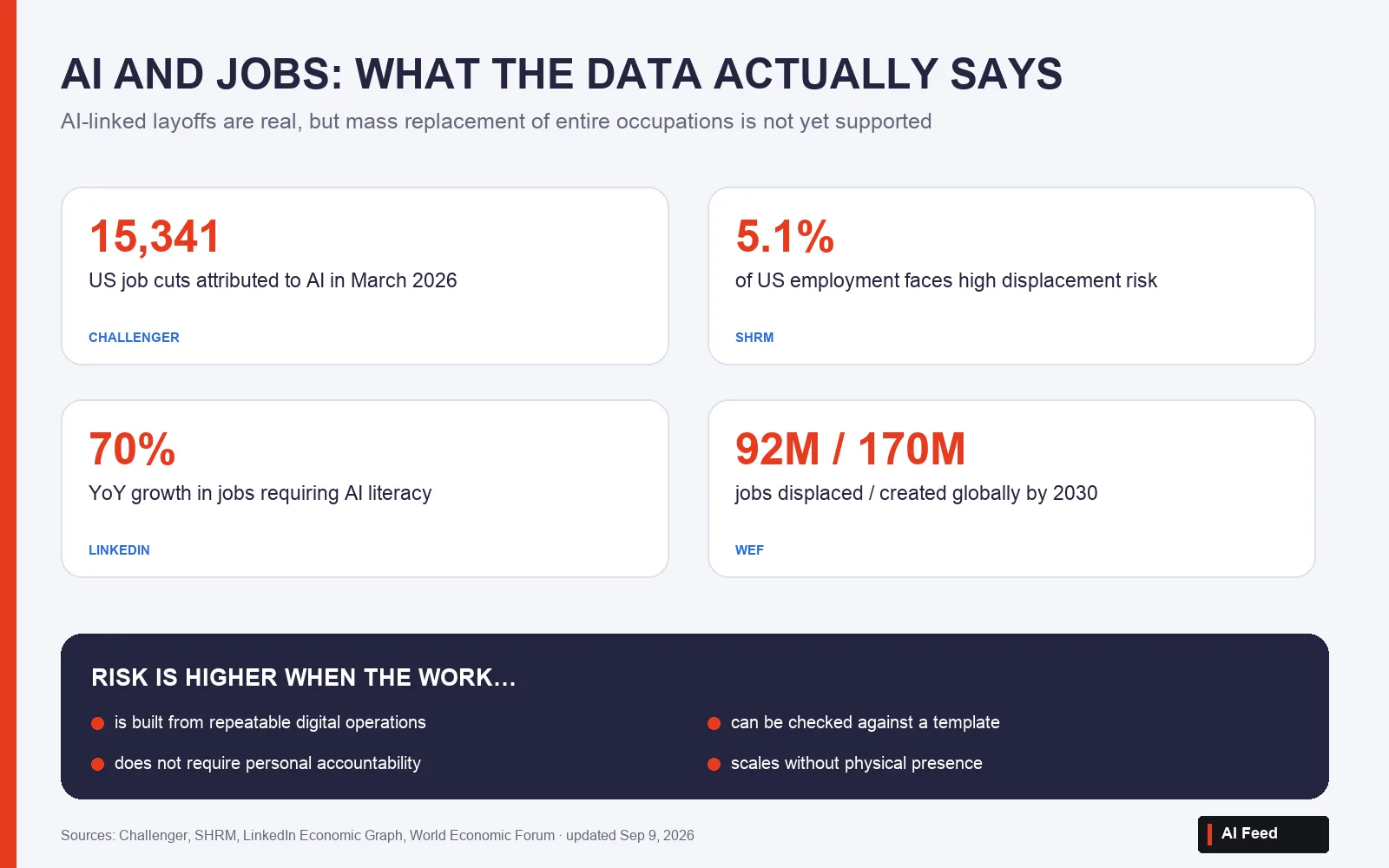
- US employers attributed 15,341 announced job cuts to AI in March 2026, one quarter of the monthly total.
- AI is still not the sole or largest explanation for a weak labor market; economic conditions, closures and restructuring matter more overall.
- Risk is highest for repeatable digital tasks with clear templates, especially in entry-level roles.
- Demand is growing for people who can direct agents, validate output and remain accountable for decisions.
How many jobs have actually been cut because of AI?
The clearest recent count comes from Challenger, Gray & Christmas. In March 2026, US employers cited artificial intelligence in 15,341 planned job cuts, representing 25% of the monthly total. During the first quarter, AI was cited in 27,645 cuts, roughly 13% of all announced reductions.
Those figures do not make AI the single cause of the employment slowdown. Market conditions, restructuring, business closures and lost contracts produced more announced cuts over the quarter. A company statement also cannot prove that every eliminated position was fully replaced by a model or agent.
Is AI taking jobs or changing them?
The useful unit of analysis is a task, not a job title. A model can draft a contract, identify a coding error or assemble a report while the final decision still requires context, accountability and review. OpenAI’s jobs transition framework stresses that technical capability does not automatically eliminate an occupation. Lower costs can sometimes expand demand for a service.
LinkedIn also finds no simple mass-displacement pattern. Global hiring remains around 20% below its pre-pandemic level, driven primarily by macroeconomic conditions. At the same time, US jobs requiring AI literacy grew 70% year over year, and approximately 1.3 million AI-enabled roles emerged globally over two years.
Which jobs will AI replace first?
It is more accurate to score the structure of daily work than the occupation as a whole. The following editorial matrix uses four signals: repetition, digital delivery, ease of verification and the ability to perform the task without physical presence. It is a task-risk guide, not a forecast of job losses.
| Occupation or role | Task risk | What can be automated | What remains human |
|---|---|---|---|
| Data-entry operator | High | Transfer, classification and record matching | Exceptions and quality control |
| Tier-one support | High | Knowledge-base answers and routing | Conflict, empathy and unusual cases |
| Junior copywriter | High | Drafts, headline variants and adaptation | Reporting, interviews, viewpoint and accountability |
| Transactional accountant | Medium-high | Extraction, reconciliation and routine entries | Tax judgment and disputed transactions |
| Junior analyst | Medium-high | Summaries, SQL drafts and standard charts | Framing questions and interpreting causes |
| Software developer | Medium | Boilerplate, tests, migrations and documentation | Architecture, constraints and system accountability |
| Lawyer | Medium | Research, contract comparison and drafts | Strategy, negotiation and legal responsibility |
| Clinical professional | Low | Documentation and diagnostic support | Examination, treatment, trust and clinical accountability |
| Skilled trades | Low | Planning, instructions and inventory control | Work in changing physical environments |
Why entry-level workers are more exposed
Junior employees traditionally learned through summaries, initial research, routine messages and small corrections. These are exactly the tasks generative systems handle first. A company may gain efficiency today while weakening the pipeline that creates experienced professionals for tomorrow.
In Anthropic’s June 2026 survey, more than a third of respondents assigned a probability above 60% to a junior colleague losing a job within a year. This measures perceived risk rather than completed layoffs, but it shows where workers expect the strongest pressure.
Why AI will not replace everyone
SHRM provides a useful correction to sweeping predictions. About 20% of US employment already contains work that is at least half automated. Yet only 5.1% is both highly automated and free from major nontechnical barriers to displacement. Those barriers include regulation, accountability, customer preference, physical presence, internal processes and the cost of errors.
A cashier, engineer, physician and executive may all use the same model, but the employment effect will differ. Generating an answer is only one component of a production system.
What happens by 2030?
The World Economic Forum expects major reallocation. Across technology, demographic and economic trends, 92 million existing jobs may be displaced and 170 million may be created by 2030. The net result is positive, but that offers little comfort to workers whose current skills no longer fit the redesigned role.
Employers expect work performed primarily by humans, primarily by technology and jointly by both to approach an even three-way split by the end of the decade. The operating model shifts from people executing every step to people designing workflows, delegating execution and approving outcomes.
How to assess your own exposure
- Break your week into tasks. Do not score the job title as one block.
- Mark repeatable digital operations. Messages, summaries, search, classification and data transfer move first.
- Measure the cost of error. Legal, financial and physical responsibility preserve human control.
- Identify the decision owner. Producing an answer and approving it are separate functions.
- Learn to manage agents. Value moves toward context, task design, validation and integration.
Skills that make a career more resilient
- verifying facts, calculations and sources;
- deep domain expertise;
- workflow and automation design;
- handling uncertainty and exceptions;
- negotiation, trust and personal accountability;
- information security and access management;
- measuring the economics of AI deployment.
Will AI replace human workers?
AI is already replacing individual tasks and influencing team size, but the evidence does not yet support mass disappearance of occupations. Entry-level office work and roles centered on repeatable information processing will change fastest. People who own outcomes, operate in the physical world or combine domain expertise with automation will be more resilient.
The defining labor-market risk of 2026 is not a universal digital employee. It is the gradual disappearance of simple tasks through which people once entered a profession and acquired experience.
Frequently asked questions
Which jobs will disappear because of AI?
Routine work in data entry, support, standard content production and administration is shrinking first. Full occupational disappearance depends on regulation, accountability, demand and automation cost.
Will AI replace programmers?
AI reduces time spent on boilerplate, tests and documentation while increasing the value of architecture, security, business understanding and accountability for a working system.
Is technology still a safe career?
Yes, when training includes AI tools, systems thinking and practice with real constraints. Demand is shifting from producing isolated code toward building and operating complete solutions.
Should I change careers because of AI?
Most people should first change their skill mix: automate repetitive work, deepen domain expertise and learn to validate model output. A complete career change is not necessary for everyone.
Sources and methodology
- Challenger Report, March 2026
- LinkedIn Economic Graph: Building a Future of Work That Works
- SHRM: Automation, AI, and Job Displacement Risk, 2026
- World Economic Forum: Future of Jobs Report 2025
- Anthropic Economic Index: Cadences
- OpenAI: Modeling an AI Jobs Transition
Updated September 9, 2026. Global forecasts and US labor data show the direction of change and should not be transferred directly to every national labor market.