

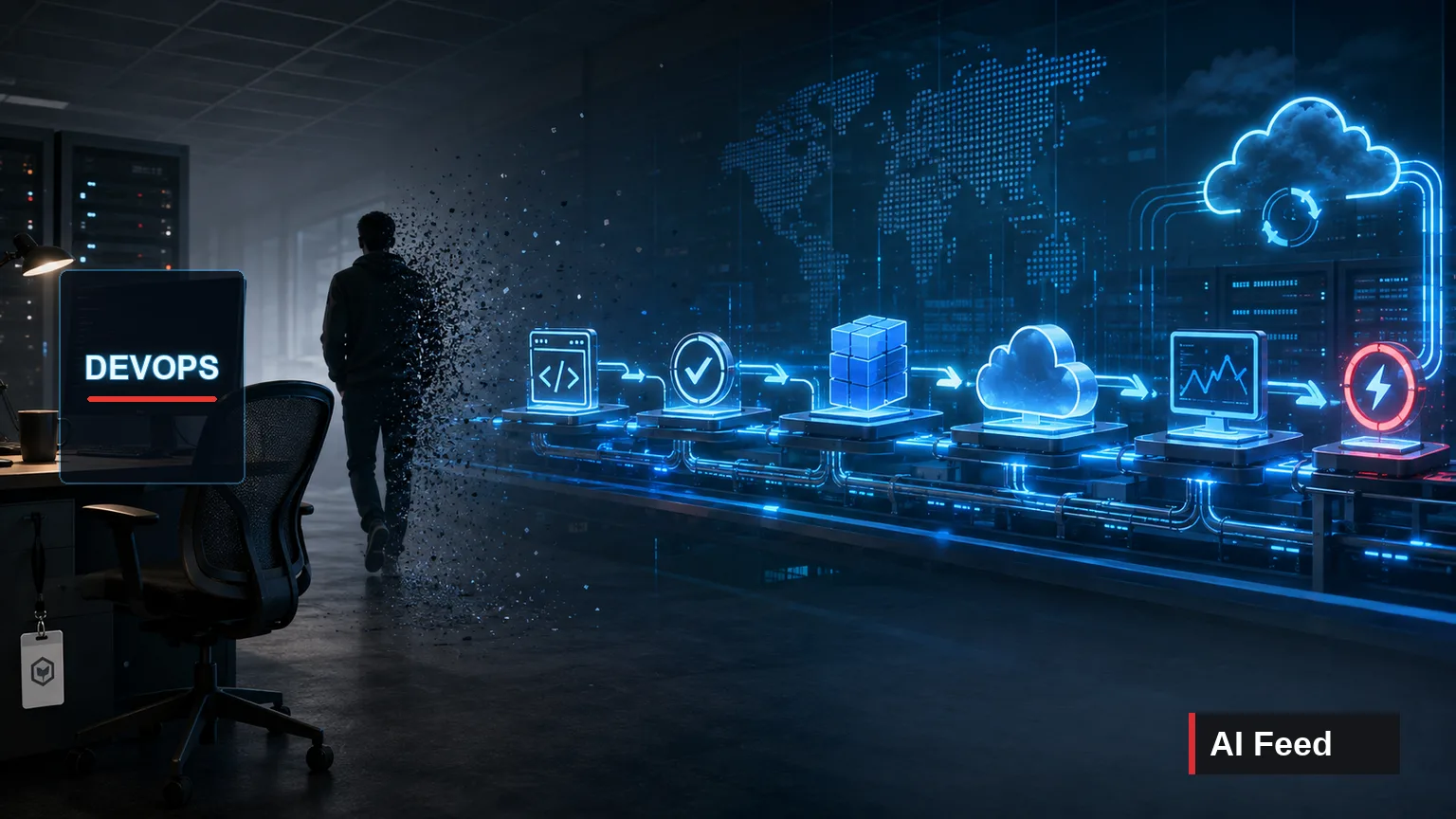
Short answer: AI will not remove accountability for production, but it is already turning much of manual DevOps into a platform capability. The role disappears gradually: first the repetitive pipeline, configuration, alert triage and runbook work; then the organizational need for a large intermediary operations team.
Why DevOps is highly exposed to automation
Infrastructure is already represented as code and telemetry. Declarative manifests, CI/CD definitions, logs, metrics, traces, runbooks and policy engines give agents machine-readable state plus a constrained action surface. Repetitive work can therefore move from a human queue into self-service.
What the evidence shows
Google Cloud’s 2024 DORA report says more than 75% of respondents used AI for at least one daily professional responsibility. A 25% increase in AI adoption was associated with 7.5% better documentation quality, 3.4% better code quality and 3.1% faster code review.
In a randomized study of 202 experienced developers, GitHub reported that Copilot users were 53.2% more likely to pass all ten tests and produced 13.6% more lines per readability error. A separate GitHub–Accenture study reported 8.69% more pull requests per developer, a 15% higher merge rate and 84% more successful builds. These are vendor studies, not universal guarantees, but they show where capacity is increasing.
Operations are also becoming agentic. Amazon CloudWatch investigations gathers telemetry, forms root-cause hypotheses and suggests remediation. Microsoft’s 2025 Work Trend Index says 46% of leaders already use agents to automate complete workstreams or business processes.
| Stage | Manual model | AI-native model | Human responsibility |
|---|---|---|---|
| Infrastructure | Hand-written templates | Generation from platform catalog and policy | Design golden paths |
| CI/CD | Maintain YAML and integrations | Agent builds and repairs pipelines | Define mandatory checks |
| Observability | Inspect dashboards | Correlate telemetry and changes | Validate diagnosis |
| Incidents | Find runbooks and commands | Prepare hypothesis, rollback and report | Approve risky actions |
| Cost | Periodic review | Continuous anomaly detection | Choose cost/reliability trade-offs |
The tasks likely to disappear first
Routine pipeline maintenance, first-line incident triage, standard access and environment requests, documentation drafts and planned remediation are all pattern-heavy. A platform can expose deterministic actions; an agent can translate intent, collect context and select the action; a human can remain at a risk checkpoint.
Why fewer roles are needed
When every engineer becomes more productive and the platform moves operations into self-service, the organization changes. One platform team can support more product teams. The reduction appears through frozen openings, unfilled departures and merged DevOps/platform/SRE responsibilities before it appears as a clean occupational statistic.
The strongest counter-evidence
DORA also found that a 25% increase in AI adoption was associated with an estimated 1.5% reduction in delivery throughput and 7.2% reduction in delivery stability; 39% reported little or no trust in AI-generated code. Faster local work can flood a weak delivery system with more change. Small batches, testing, observability and guardrails become more valuable, not less.
Novel incidents, architecture, blast-radius decisions, regulatory requirements and risk ownership still need accountable people. AI can prepare and sometimes execute an action, but the organization must know who authorized it and why.
The team that replaces traditional DevOps
A smaller platform/SRE team builds service catalogs, golden paths, policies, observability, safe actions and agent evaluations. Product developers operate standard paths themselves. The job title may survive, but the content shifts from ticket handling and terminal work to system design and governance.
Conclusion
AI does not make reliability unnecessary. It makes a large share of manual work historically sold as DevOps unnecessary. The likely outcome is a smaller, more senior profession combining platform engineering, SRE and AI operations: fewer people executing repetitive procedures, more responsibility concentrated in the people designing the system that executes them.
Sources and methodology
Figures reproduce the cited studies and vendor publications. DORA associations do not prove causality; vendor research should be read with its commercial context in mind.